

Creandum and Union Square Ventures (USV) have backed robotics start-up Machenta in a $40m (£30m) seed funding round, described by Imperial College London as the largest ever raised by a UK robotics start-up.
The funding will support the development of Machenta’s robot foundation model, which enables machines to learn new tasks from a single demonstration rather than requiring repeated human demonstrations and lengthy training processes.
The company’s technology is designed to allow robots to adapt to tasks they have not encountered before. While conventional robot-learning models often rely on large datasets of real-world demonstrations, Machenta’s model is pre-trained entirely on simulated data.
This approach is intended to make the training process more scalable and reduce the practical and privacy constraints associated with collecting large volumes of human-generated data.
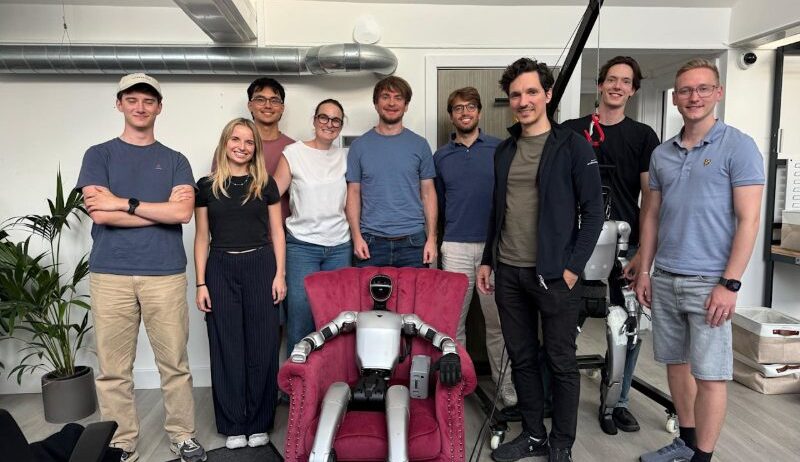
The technology builds on six years of research at Imperial College London, where Machenta co-founder and chief executive Professor Edward Johns established the Robot Learning Lab to investigate how robots could learn physical skills at a similar speed to humans.
Johns founded Machenta with former PhD student Vitalis Vosylius and colleagues from the university’s research lab to commercialise the work.
The team has demonstrated how a single model can learn a range of tasks, including packing and tidying, across different types of robots, including humanoid machines. The technology is intended to allow users to teach robots by demonstrating a task, rather than relying on specialist programming or repeated training.
Johns said: “Intelligence is not so much about what you can already do, it’s about how quickly you can learn to do something new. Humans don’t need to see the same thing over and over before they can do it. If you take some objects, and show somebody what to do with them, they’ll probably then be able to do the same task immediately. We’ve spent years trying to understand what it would take for robots to learn at the speed of a human. That is what instant robot learning is about.”
Kathi Wilhelm, partner at Creandum, added: "Very few teams in robotics can point to a body of work like this, which has repeatedly changed what people thought was possible. The team at Machenta has spent years breaking through this extremely hard problem, long before there was a company around it. They’re not starting with just a theory of how robots can learn like humans; they’re building on years of experience actually making it happen.”